
Table of Contents
- Introduction
- Why Flow Control Matters
- Key Components of a Flow Control Valve
- Working Principle
- Types of Flow Control Valves
- Applications Across Industries
- How to Select the Right Valve
- Advantages & Disadvantages
- Conclusion
How Flow Control Valves Work: A Complete Guide
A flow control valve is used in fluid systems to regulate the rate and the pressure of fluid flow. Whether the medium is liquid, gas, or steam, these valves ensure that the system operates safely, efficiently, and within desired performance parameters. Simply put, a flow control valve helps manage “how much” and “how fast” a fluid moves through a pipeline or system. Without proper flow control, flow variations can cause energy loss, equipment damage, and reduced system efficiency.
Why Flow Control Matters in Fluid Systems
Controlling flow isn’t just about regulating quantity it’s about maintaining stability and efficiency. In industrial processes, even slight fluctuations in flow can disrupt operations.
- In hydraulic systems, it ensures smooth actuator movement.
- In chemical and process industries, it maintains precise mixing ratios.
- In HVAC and water systems, it optimizes energy use and system performance.
Flow control valves also help maintain consistent pressure, protect pumps, and prevent cavitation or leaks. Overall, they are crucial for reliability, safety, and cost-effective operations.
Key Components of a Flow Control Valve
Although there are many variations in design among flow control valves, they generally have a few components in common:
- Body: The main structure that encloses the internal parts and connects to pipeline.
- Trim: Internal parts such as discs, plugs, and seats that directly interface with the flow.
- Actuator: Changes control signals into mechanical motion to open or close the valve.
- Bonnet: Covers the valve stem and sealing components.
- Valve Seat: Provides a sealing surface that prevents leakage.
- Stem: Transfers motion from actuator to trim.
- Handwheel: The handwheel is a manual control component used to operate the valve.
- Valve Packing: A sealing material placed around the valve stem inside the bonnet to prevent leakage along the stem while allowing smooth movement.
Flow Control Valve Working Principle Explained
The basic operating principle of a flow control valve is to regulate the rate of fluid or air flow by creating a controlled restriction within the flow path. By adjusting the size of the passage—using components such as a needle, disc, or orifice—the amount of fluid that can pass through at any given time is directly affected.
When the opening area is reduced, the restriction increases, resulting in higher resistance to flow. As a result, the flow rate decreases and actuator movement slows down. Conversely, when the opening area increases, resistance is reduced and the flow rate rises. This throttling action also creates a pressure drop across the valve, which is essential for maintaining precise flow control.
More advanced designs, such as pressure-compensated flow control valves, automatically maintain a constant flow rate even when system pressure varies. This ensures consistent performance and protects equipment from sudden changes in speed.
Different Types of Flow Control Valves
There are several types of flow control valves, each suited for specific functions and media types:
1. Gate Valve
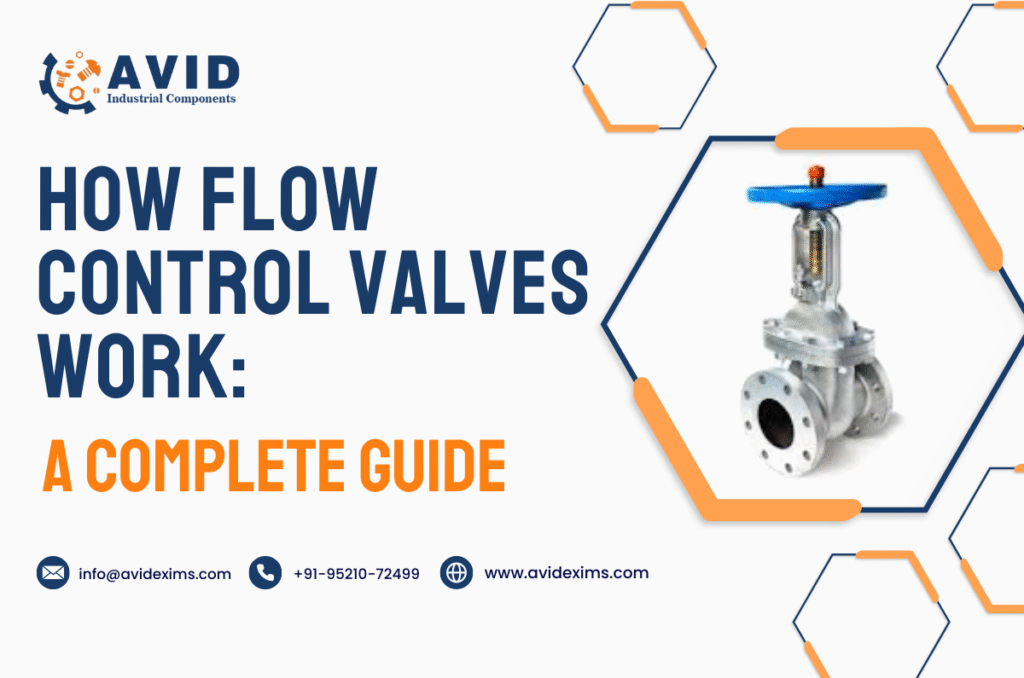
Designed for on/off control rather than throttling. It operates by raising or lowering a gate to start or stop flow. Commonly used in pipelines for isolation.
2. Plug Valve
Features a cylindrical or conical plug with a passageway that aligns with the flow when open. Known for quick operation and simple design.
3. Needle Valve
Ideal for precise flow regulation, especially in small systems or metering applications. It has a slender, tapered point for fine control.
4. Non-Return Valve (Check Valve)
Allows fluid to flow in only one direction, preventing backflow that could damage equipment or contaminate systems.
5. Butterfly Valve
Lightweight and compact, it uses a rotating disc to regulate flow. Common in water treatment, HVAC, and food industries.
6. Pressure-Compensated Flow Control Valve
Maintains constant flow regardless of input pressure variations—perfect for hydraulic systems requiring consistent actuator speed.
7. Pinch Valve
Uses a flexible rubber sleeve pinched mechanically or pneumatically to control flow. Excellent for slurries and corrosive fluids.
8. Globe Valve
Named for its spherical body, it provides good throttling characteristics and is widely used in process control applications.
9. Diaphragm Valve
Uses a flexible diaphragm to regulate flow. Often used in sanitary or chemical processes due to its leak-proof and contamination-free operation.
10. Ball Valve
One of the most common types, using a rotating ball with a bore. Offers quick shut-off and minimal pressure drop.
Common Applications Across Industries
Flow control valves are used across multiple industries, including:
- Oil & Gas: For regulating flow in pipelines and refining systems.
- Water Treatment: Ensures consistent pressure and flow in filtration units.
- Pharmaceuticals & Food Processing: For hygienic flow control and clean-in-place systems.
- HVAC Systems: Balances water flow through heating/cooling coils.
- Automotive & Aerospace: Controls hydraulic and pneumatic operations.
Their versatility and reliability make them indispensable in any system involving fluid dynamics.
How to Select the Right Flow Control Valve for Your System
Selecting the appropriate flow control valve is important to making your system reliable, secure, and effective. Here are the important points you should consider before making a selection.
1. Fluid Type
Match the valve to the medium:
- Liquids: Ball, globe, gate valves
- Gases: Needle or plug valves with tight sealing
- Slurries/viscous fluids: Pinch or diaphragm valves
- Corrosive chemicals: PTFE-lined, PVC, or stainless steel valves
2. Pressure & Temperature
Select a valve that meets or exceeds system limits:
- High pressure: Needle or pressure-compensated valves
- Low pressure: Butterfly or globe valves
- High temperature: Metal alloys with heat-resistant seals
- Cryogenic: Materials designed to avoid brittleness
3. Flow Rate (Cv Value)
- Ensure the valve provides the required flow capacity.
- Too small: Excessive pressure drop
- Too large: Poor control and instability
- Precise control: Use needle valves
- High volume: Ball or butterfly valves
4. Control Type (On/Off vs. Throttling)
- On/Off: Ball, gate, plug valves
- Throttling: Globe, needle, pressure-compensated valves
- Avoid throttling valves not designed for it (e.g., gate valves).
5. Installation Space & Maintenance
- Tight spaces: Butterfly or ball valves
- Hard-to-reach areas: Valves with remote actuators
- Frequent maintenance: Diaphragm or plug valves
6. Material Compatibility
Choose materials suited to fluid and environment:
- Stainless steel: High pressure/temperature, corrosive fluids
- Brass: Water, air, non-corrosive fluids
- PVC/CPVC: Low-pressure, chemical or water applications
- Carbon steel: Industrial fluids with moderate corrosion
- PTFE/rubber linings: Highly corrosive or abrasive media
Advantages and Disadvantages of Flow Control Valves
Advantages:
- Precise control over flow rate and pressure.
- Protects system components from overload or cavitation.
- Improves energy efficiency.
- Available in various designs for specific needs.
- Durable and reliable with proper maintenance.
Disadvantages:
- Can be expensive in high-performance materials.
- Regular maintenance is required for optimal operation.
- Flow restrictions may lead to pressure losses.
- Sensitive to contamination in certain valve types.
Conclusion
Flow control valves are the heart of fluid systems, ensuring that everything operates smoothly, safely, and efficiently. Understanding their working principles, types, and selection criteria helps engineers design systems that minimize energy waste and maximize reliability. Whether in an industrial plant, a water network, or a hydraulic setup, the right flow control valve can make all the difference between a system that merely runs — and one that runs perfectly.